
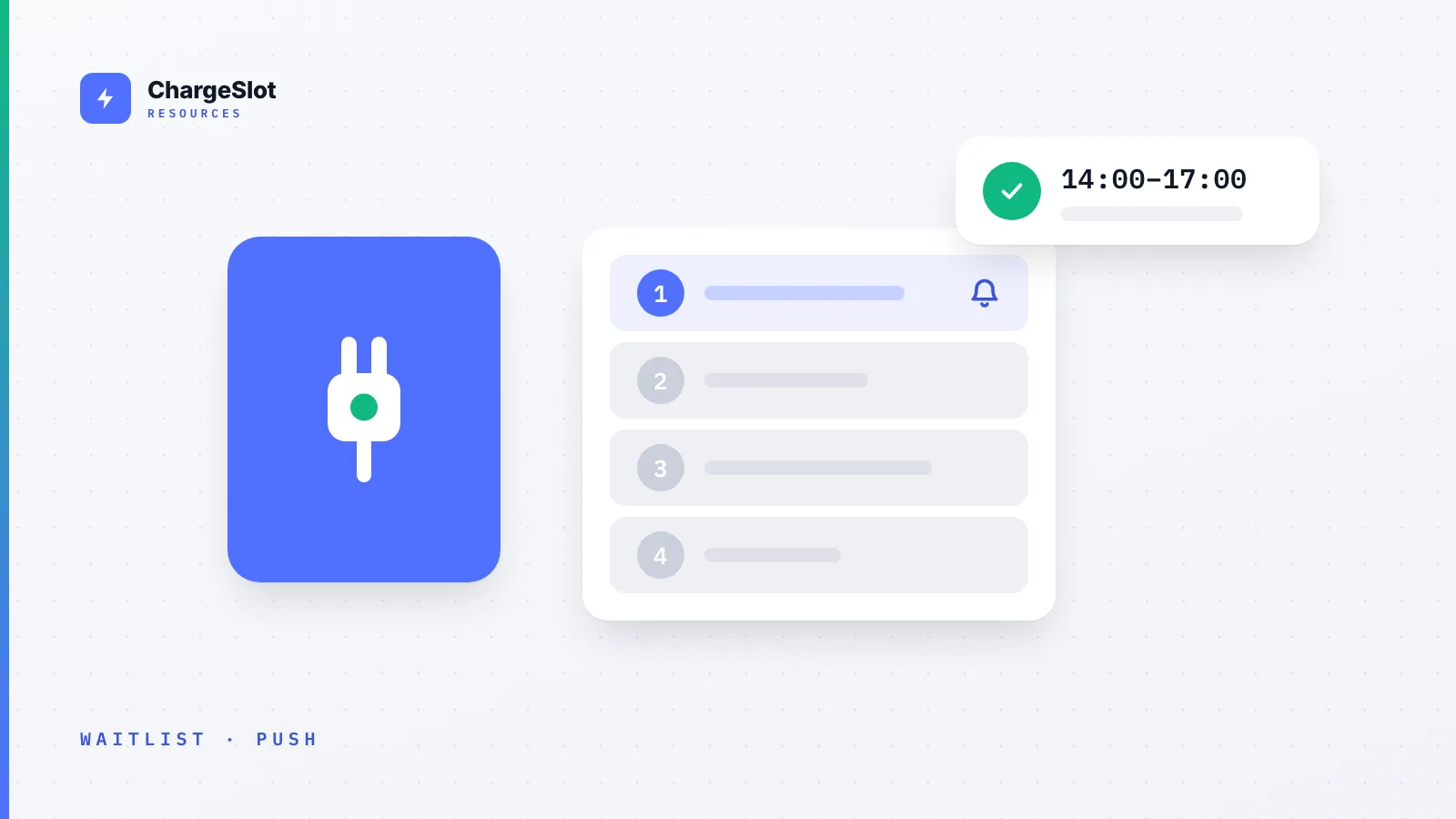
When you have more EVs than chargers, the problem is rarely the hardware. It's how access is shared. Fixed time slots with a maximum duration get more cars through the same charger, and a waitlist settles who goes next when everything is booked: the first person to join is the first to hear when a slot opens up. That replaces "anyone moving soon?" messages and early-bird parking with an order everyone can see.
Signs you've hit the limit
A charging shortage rarely announces itself with a complaint. It shows up as habits:
- Some people arrive earlier and earlier to get "their" charger.
- The team chat fills with questions about who is moving their car when.
- The same few people always charge, and others have given up trying.
- Cars stay plugged in all day because nobody expects them to move.
Once you see these, it's time to organize access. Every additional EV on the team makes the friction worse.
Why first come, first served isn't fair
Without a rule, the charger goes to whoever arrives first. That favours people with flexible hours and short commutes, and it rewards staying put: once you've got the bay, you keep it. Someone who really needs to charge but starts later misses out. And nobody knows whether it's even worth walking down to the car park.
Rules first, waitlist second
A waitlist shares out scarcity. Rules are what create more capacity. Before you think about a waitlist, put these in place:
- Time slots instead of all-day parking: with an 8 am to 5 pm working day and three-hour slots, one charger serves up to three cars instead of one.
- A maximum duration per booking, so slots actually rotate.
- A daily booking limit per person and a cap on open bookings at once, so nobody holds several slots.
- A short booking horizon: if people can only book a few days ahead, nobody can claim the whole month.
- Release on no-show: anyone who doesn't check in gives the slot back automatically after a grace period. See our guide on blocked chargers and no-shows.
The waitlist only comes in when everything is booked despite those rules.
How a fair waitlist works
ChargeSlot keeps one waitlist per charger per day. If drivers can't find a free slot when booking, they can join with one tap, for today or a later day within the booking horizon.
- The order is the order people joined. First in is first in line, with no priority by department or seniority.
- A slot opens up when someone cancels, when a booking is released because nobody checked in, or when someone ends their session early with enough time left over.
- The first person in line is notified in the app, by email, and by push notification if they've turned push on.
- The notification is a heads-up, not a reservation. The slot isn't booked automatically. Whoever wants it books it. That waitlist entry is then complete, and anyone who misses out can simply join again.
Why not book automatically?
Automatic booking sounds convenient, but it recreates the very problem you're trying to solve: slots held for people who can't use them right now. Someone who joined in the morning may be in a meeting or on the road by lunchtime. An auto-booked slot would then sit empty until the grace period runs out. A notification leaves the decision with the one person who knows whether they can be at the charger in twenty minutes.
What the waitlist tells you as the person in charge
Every failed booking attempt is a data point. When drivers couldn't get a slot, ChargeSlot sends the people in charge a weekly summary: how many people were affected and a deliberately cautious estimate of how many extra chargers would have covered the busiest day. Only genuine shortages count, and each person counts once, not every retry.
That turns "it feels tight" into a number you can take to the next budget meeting.
Rolling out a waitlist
- Set the rules: slot length, maximum duration, per-person limits and grace period.
- Write them down, for example with our charging policy template.
- Explain to the team how the waitlist works, especially that a notification is not a reservation.
- Ask drivers to turn on push notifications. A free slot is usually taken again quickly.
- After a few weeks, look at utilization and the weekly summary, and tighten the rules if needed.
FAQ
Can drivers join the waitlist for several chargers?
Yes. The waitlist is per charger and per day, so joining several is possible. What they can actually book is still capped by the per-person limits.
What if the person notified doesn't respond?
The slot stays open to everyone, and whoever books first gets it. A free slot is never held for someone who may not use it.
Is this fair to part-time staff?
Fairer than first come, first served. Per-person daily limits apply equally to everyone, and the waitlist order doesn't depend on who gets to the office earliest.