
There are two ways to work out EV charging costs per employee: estimate them from charging time, charger power and your electricity price, or measure each session with a metered charger or a sub-meter. An estimate needs no extra hardware and is good enough for budgeting and internal cost allocation. You need measured values once you reimburse, recharge or have to prove costs to the kilowatt-hour. So the purpose decides the method, not the technology.
What do you need the number for?
Before thinking about meters and formulas, be clear about what the result is for. That decides how accurate it has to be:
- Budget and overview: what does charging cost us each month, and where is it heading? An estimate is enough.
- Internal cost allocation: cost centres, departments or tenant companies in a shared building pay their share. A transparent estimate usually works, provided everyone knows the method.
- Tax records: whether employer-paid charging is tax-free or a taxable benefit depends on where you are. Check with your tax adviser what you need to document.
- Reimbursement or recharging: as soon as money changes hands per kWh between people or companies, you need measured values. Many countries also have metrology rules for selling or billing electricity per kWh to third parties.
Method 1: estimate
An estimate works out roughly how much energy a session used and multiplies it by your electricity price:
- Energy (kWh) ≈ time plugged in (h) × charger power (kW) × utilization factor
- Cost = energy (kWh) × price per kWh
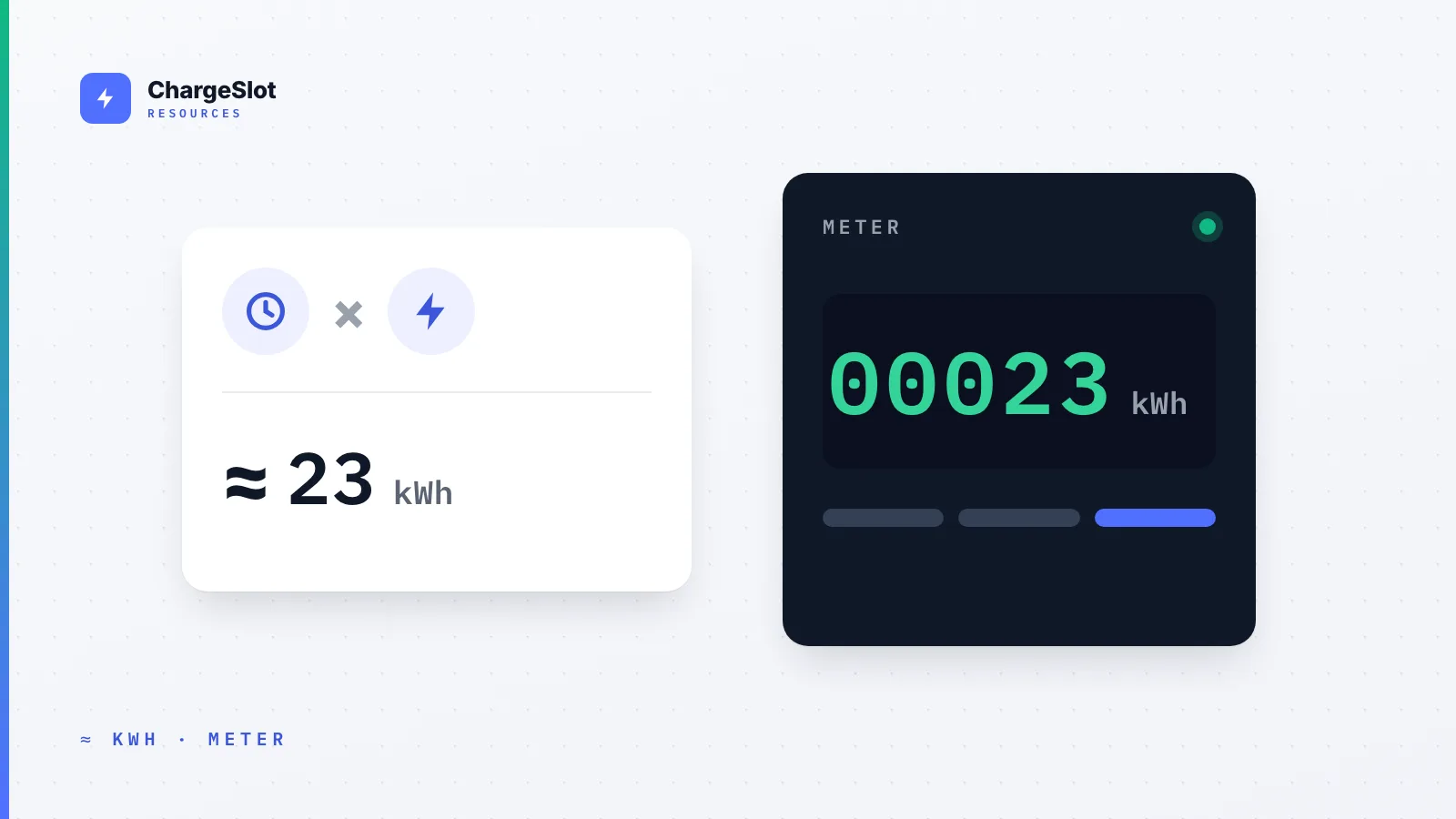
An example: a car spends three hours on an 11 kW charger. With a utilization factor of 0.7, that's about 23 kWh. At a price of 0.30 per kWh, the session cost just under 7 in your currency.
Three assumptions decide how good the estimate is:
- Actual time, not booked time: use the time the car was really at the charger, not the slot that was booked. A session that ended early, or a booking nobody used, mustn't count as a full slot.
- The utilization factor: cars rarely draw full power for the whole session. Some on-board chargers accept less than the charger can deliver, and power drops as the battery fills up. The factor accounts for that. Set it, write it down, and check it against real readings once you have some.
- The electricity price: use one fixed, documented price per kWh, for example from your supply contract, and state whether it includes tax.
The strength of an estimate is that it works today, with any charger and nothing to install. Its limit is that it stays an estimate and should be labelled as one wherever it appears. It's not a basis for billing to the kWh.
Method 2: measure
With measurement, the energy per session comes from a meter. There are three common set-ups:
- A charger with a built-in meter and driver identification: the charger records kWh per session and links it to a person through an RFID card or app. The data sits in the manufacturer's cloud or a charging back end.
- Meter values via OCPP: OCPP-capable chargers send meter readings to a back end, which assigns them to sessions.
- A sub-meter per charger: it measures the charger's total consumption. You only get per-person figures once you match the readings with session times.
The strength of measurement is real numbers instead of assumptions. Its limits are hardware, set-up and possibly ongoing connection fees, plus metrology requirements if you bill third parties to the kWh.
Estimate vs. measurement
| Estimate | Measurement | |
|---|---|---|
| Hardware | Nothing extra | Metered charger, OCPP connection or sub-meter |
| Effort | Low: set a price and a factor | Set-up, matching, upkeep |
| Accuracy | Plausible, depends on assumptions | Exact per session |
| Good for | Budget, overview, internal allocation | Reimbursement, recharging, proof |
| Watch out for | Label it as an estimate everywhere | Metrology rules when billing |
You don't have to choose one for good. A practical approach is to start with the estimate and use measured values wherever you have them, with each line showing whether its figure is measured or estimated.
Five steps to a cost overview
- Agree the purpose: overview, cost allocation, records or billing?
- Get the data: whichever method you choose, you first need to know who was at which charger, when and for how long.
- Fix the method and assumptions: write down the electricity price, the utilization factor and how costs map to cost centres.
- Report monthly: by person, site or cost centre, depending on the purpose.
- Tell people: drivers should know whether and how their sessions are analysed. If it belongs in your charging rules, our guide to creating a workplace charging policy helps.
Where the data comes from
Step 2 doesn't need to be a project of its own if your chargers are already booked. For every booking, ChargeSlot records who booked which charger for which time and when the booking actually ended, including bookings that were released or ended early. That's the data an estimate can be built on.
FAQ
Is an estimate good enough for the tax authorities?
That depends on the country and the purpose, so ask your tax adviser. For internal cost allocation, a documented estimate is usually enough.
Which electricity price should we use?
One fixed, documented price per kWh, such as the energy rate in your supply contract, with a note on whether it includes tax. What matters is that every report uses the same price until you deliberately change it.
What about charging at home?
That's a separate topic with its own rules, which vary by country. A dedicated home charger with its own meter is the usual way to get reliable figures.